Annual
Subscribe for one year to access all your favourite downloads
500 / year
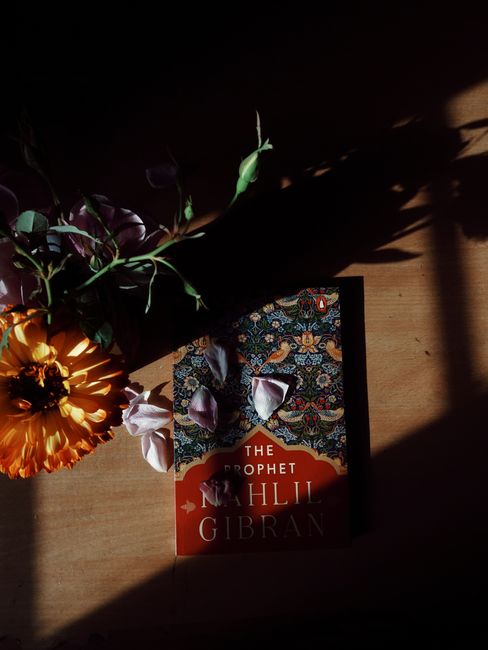

Certain books don’t merely offer advice; they re-calibrate our entire perspective. Kahlil Gibran’s The Prophet is one such work. Published in 1923, it has quietly become a spiritual touchstone, not by providing rigid answers, but by challenging the very foundations of our most common beliefs. It asks us to unlearn what society has taught us about love, family, work, and even our own emotions. Through the poetic sermons of a departing sage named Almustafa, Gibran offers a blueprint for a life lived with greater intention, freedom, and depth. It is a guide for anyone who suspects there is more to our existence than the roles we are expected to play.
Gibran’s most revolutionary ideas concern our relationships, where he dismantles the concepts of ownership and codependency with profound gentleness.
In a world that often equates love with fusion, Gibran’s wisdom is a breath of fresh air. He famously advises, “Let there be spaces in your togetherness.” This isn’t a call for distance, but for a healthier form of intimacy where individuality is not sacrificed but celebrated. He suggests that partners should be like “the pillars of a temple,” standing together yet apart, supporting a common roof without collapsing into one another. This vision of love is one of mutual respect, where connection thrives on the strength of two whole individuals, not the merging of two halves.
Taking the next step becomes straightforward when you have the right support — Become an Ultimate Master of your life is worth exploring.

Taking the next step becomes straightforward when you have the right support — Heal your past, design your future is worth exploring.
Perhaps his most startling counsel is reserved for parents. The declaration, “Your children are not your children. They are the sons and daughters of Life’s longing for itself,” directly confronts the notion of parental possession. Gibran reframes the parent’s role from one of a molder to that of a guardian—or a “bow” from which children, as “living arrows,” are sent forth. The parent’s job is to provide a stable, loving foundation for the child’s own journey, not to dictate its destination. It’s a radical act of letting go, rooted in unconditional love.
Gibran applies a philosophy of unity to our internal worlds, arguing that what we perceive as opposites are often two sides of the same coin.
Rather than treating sorrow as an enemy to be vanquished, Almustafa presents it as an essential force for growth. He explains, “The deeper that sorrow carves into your being, the more joy you can contain.” This powerful metaphor transforms pain from a pointless affliction into a process that expands our capacity for happiness. According to Gibran, one cannot be selectively open to life; to experience ecstatic joy, we must also be willing to face profound sorrow. They are inextricably linked, each giving meaning to the other.
In an age of burnout and disillusionment with work, Gibran’s perspective is more relevant than ever. He elevates labor from a mere transaction to a spiritual act, stating that “work is love made visible.” This simple phrase encourages us to see our daily tasks, however mundane, as an opportunity to pour our care and creativity into the world. Similarly, he distinguishes between two types of generosity: giving of possessions, which is easy, and giving of oneself, which is the only true form of giving. This re-consecrates the everyday, suggesting that our purpose is found not in grand gestures, but in the love we embed in our daily efforts.
The book’s structure—a series of 26 prose poems delivered by the prophet Almustafa as he awaits a ship to take him home from the city of Orphalese—is key to its power. This narrative frame creates a sense of profound, distilled wisdom. These are not casual thoughts but the final, essential truths a wise man wishes to leave behind. By placing these universal teachings in the mouth of a single, compassionate figure, Gibran makes them feel both personal and timeless. For a century, readers of all faiths and backgrounds have found a common language in Almustafa’s words, turning to them at weddings, funerals, and moments of private reflection, proving that the deepest truths need no dogma to resonate within the human heart.
 Man’s Search for Meaning Review: Frankl’s Lessons on SufferingGeneral
 The Power of Now Review: Summary, Lessons & Core MessageGeneral
 The Power of Now Review: Lessons from Eckhart Tolle’s GuideGeneral
 Book Review: The Prophet by Kahlil Gibran — Summary & LessonsGeneral
 The Biology of Belief Review: Key Lessons & SummaryGeneral
 Book Review: Breaking the Habit of Being Yourself by Dr. Joe DispenzaGeneral
 Book Review: Breaking the Habit of Being Yourself by Joe DispenzaGeneral
 The Power of Now Book Review: Lessons from Eckhart TolleGeneral
 The Power of Now Review: Lessons & Summary of Tolle’s ClassicGeneral
 The Power of Now Review: Summary, Lessons & Why It Still MattersGeneralMan’s Search for Meaning Review: Frankl’s Lessons on SufferingGeneralThe Power of Now Review: Summary, Lessons & Core MessageGeneralThe Power of Now Review: Lessons from Eckhart Tolle’s GuideGeneralBook Review: The Prophet by Kahlil Gibran — Summary & LessonsGeneralThe Biology of Belief Review: Key Lessons & SummaryGeneral
Sign in without leaving this document. You will return here automatically.

The Ultimate Masters
https://www.ultimatemasters.org
Subscribe for one year to access all your favourite downloads
500 / year
Unlimited downloads forever
Unlimited downloads
Subscribe for one to access hundreds of downloads.
50 / month
Subscribe quarterly/per term
75 / month
The Ultimate Masters
https://www.ultimatemasters.org
Continue directly to this store’s secure WooCommerce checkout.
Earn direct and team commission with personal links, campaign creatives, discount coupons and transparent reporting.
0 responses on "Book Review: The Prophet by Kahlil Gibran — Summary & Lessons"