



Annual
Subscribe for one year to access all your favourite downloads
500 / year


Haemin Sunim’s Love for Imperfect Things is a self-help book offering Buddhist-inspired guidance on self-acceptance and navigating life’s challenges. The text provides excerpts exploring themes of self-care, family relationships, empathy, courage, healing, and enlightenment. Sunim shares personal anecdotes and offers practical advice for overcoming difficulties, emphasizing compassion, mindfulness, and letting go of perfectionism. The book encourages readers to embrace imperfections, both within themselves and others, fostering healthier relationships and a more fulfilling life. It blends personal reflection with Buddhist teachings, providing accessible wisdom for a broad audience.
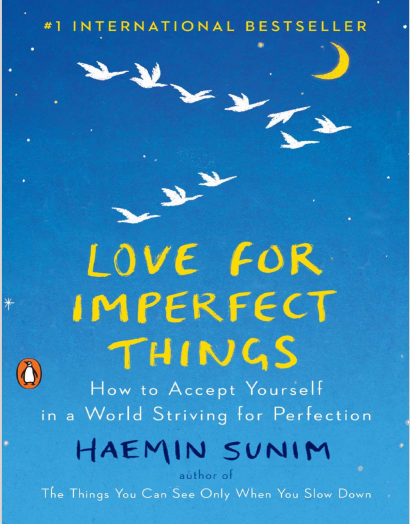
The book emphasizes accepting ourselves and others, flaws and all. It challenges the idea that we need to be “good” (compliant to others’ expectations) to be worthy of love. Instead, it encourages self-compassion, recognizing that our imperfections can motivate growth and compassion towards others. Applying this to oneself means acknowledging your flaws with love and understanding rather than self-criticism. It’s about recognizing that your existence alone is enough, regardless of your achievements or imperfections.
The book explores the difficulties that often arise in family relationships, specifically focusing on father-child relationships. It suggests that these relationships can be more complex than those with mothers. It offers several “prototypes” of father-child dynamics, such as fathers who are excessively patriarchal, and encourages readers to understand the underlying pain of parents, often rooted in their own childhood experiences. The book promotes empathy and seeing parents as individuals with their own struggles, beyond their role as a parent. It also emphasizes that while love for family is essential, it is also crucial to set boundaries in unhealthy or abusive relationships and prioritize one’s own well-being.
Cultivating empathy begins with listening without judgment and trying to understand others’ perspectives. The book suggests looking deeply into the pain of difficult people, considering that their behavior may stem from their own insecurities, past traumas, or lack of love. To be more empathic, instead of reacting with anger or judgment, consider what could be motivating the person’s actions. Additionally, the book encourages imagining yourself in their situation to better understand their feelings. This cultivates compassion and reduces the tendency to demonize those we find challenging.
The book suggests that disappointment often stems from unmet expectations. When facing disappointment, it encourages self-reflection: Why did you have that expectation? Are your expectations reasonable? It emphasizes not relying on others for happiness, suggesting that self-reliance is key. Instead of becoming bitter or resentful, the book encourages understanding the root cause of the disappointment and viewing setbacks as learning opportunities for growth and resilience. It also reminds us that failure does not define a person’s worth and that growth is a process of constant trial and error.
Listening to your inner voice means being attuned to your authentic desires and feelings, rather than always prioritizing what others want you to do. It’s about paying attention to what you truly want, not what you should want. It can be difficult to differentiate your own voice from external pressures and opinions. The book suggests not suppressing your emotions and expressing your true feelings to others. When faced with a decision, it advocates for considering your heart and intuition alongside logic and intellect. When feeling conflicted, taking time alone in nature can help restore harmony and clarity.
“The mind’s true home” refers to the peaceful silence and stillness that lies beneath our thoughts and emotions. It is not just the absence of thinking but a profound space of awareness and contentment. It’s described as the unshakeable, true nature of the mind, which is like a clear sky that accepts all types of weather (thoughts and emotions). Accessing this state is described through mindfulness and meditation practices. Specifically, the text focuses on paying attention to the gap between thoughts, gradually expanding the space of silence. This state is often associated with experiencing a sense of unity with the universe and feeling at peace, aligned with your true nature.
Present moment awareness is the practice of fully focusing on the “here and now,” rather than dwelling on the past or worrying about the future. This is crucial because it frees the mind from the prison of repetitive thoughts that fuel negative emotions and stress. When the mind is not focused on the present, it is often reliving past regrets or anticipating future anxieties. This creates distance between ourselves and the reality of the present moment. By being present, the book suggests, we can appreciate the beauty around us, find contentment in simple things, and develop a deeper sense of self-awareness. Healing and happiness are often found by focusing on the peace and quiet within us that is only accessible when fully present.
The book portrays enlightenment as the direct experience of the mind’s true nature, a state free from thoughts and filled with peace, clarity, and boundless awareness. It’s described as something that isn’t attained through a striving effort but rather revealed when the mind becomes still and silent. The book suggests that enlightenment isn’t an exclusive domain for monks, but an inherent potential in everyone. The book describes this potential through the symbolism of the empty sky (which is always there, even with clouds) and the blank mirror (which is not altered by its reflections). Instead of seeing enlightenment as a distant and arduous goal, the book emphasizes the importance of mindfulness and self-compassion on the journey. Ultimately, the book argues that the path to liberation is not about achieving something external but about realizing your own inherent potential.
Instructions: Answer each question in 2-3 sentences.
Compassion: Understanding and empathy for the suffering of others, often accompanied by a desire to help alleviate that suffering.
Empathy: The ability to understand and share the feelings of another person.
Enlightenment: A state of profound spiritual understanding and insight, often described as a liberation from suffering and the realization of one’s true nature.
Forgiveness: The act of releasing resentment and the desire for revenge, often towards someone who has wronged you. It also can be applied to forgiving one’s self.
Mindfulness: The practice of paying attention to the present moment without judgment. It involves being fully aware of one’s thoughts, feelings, and sensations.

Meditation: A practice involving techniques that aim to focus the mind, induce a relaxed state, and promote awareness and inner peace.
Namaste: A traditional Indian greeting meaning, “The divine being within me bows to the divine being within you,” emphasizing the inherent worth and sacredness of every individual.
Self-Care: The practice of taking actions to preserve or improve one’s own health, happiness, and well-being.
Self-Esteem: A realistic and positive opinion about one’s self.
Zen: A school of Mahayana Buddhism that emphasizes meditation and direct insight, focusing on the practice of awareness and presence.

 The Emotional Engine of BookTok: How Tears Built an EmpireGeneral
 The BookTok Effect: Why Crying on Camera Sells More Books Than a ReviewGeneral
 The Soul of BookTok: Identity, Emotion, and CommunityGeneral
 BookTok’s Power: How It Rewrites Publishing & Reader PsychologyGeneral
 The Emotional Engine of BookTok: Why We Cry & What It SellsGeneral
 The Emotional Engine of BookTok: Why Crying Sells BooksGeneral
 The BookTok Effect: How TikTok Redefined Reading CultureGeneral
 The Emotional Engine of BookTok: Why We Cry, Buy, and ConnectGeneral
 The Emotional Algorithm: A BookTok Review of Our Inner WorldsGeneral
 BookTok: How a TikTok Hashtag Rewrote the Rules of PublishingGeneralThe Emotional Engine of BookTok: How Tears Built an EmpireGeneralThe BookTok Effect: Why Crying on Camera Sells More Books Than a ReviewGeneralThe Soul of BookTok: Identity, Emotion, and CommunityGeneralBookTok’s Power: How It Rewrites Publishing & Reader PsychologyGeneralThe Emotional Engine of BookTok: Why We Cry & What It SellsGeneral
Sign in without leaving this document. You will return here automatically.

The Ultimate Masters
https://www.ultimatemasters.org
Subscribe for one year to access all your favourite downloads
500 / year
Unlimited downloads forever
Unlimited downloads
Subscribe for one to access hundreds of downloads.
50 / month
Subscribe quarterly/per term
75 / month
The Ultimate Masters
https://www.ultimatemasters.org
Continue directly to this store’s secure WooCommerce checkout.
Earn direct and team commission with personal links, campaign creatives, discount coupons and transparent reporting.
0 responses on "Love for Imperfect Things"