



Annual
Subscribe for one year to access all your favourite downloads
500 / year
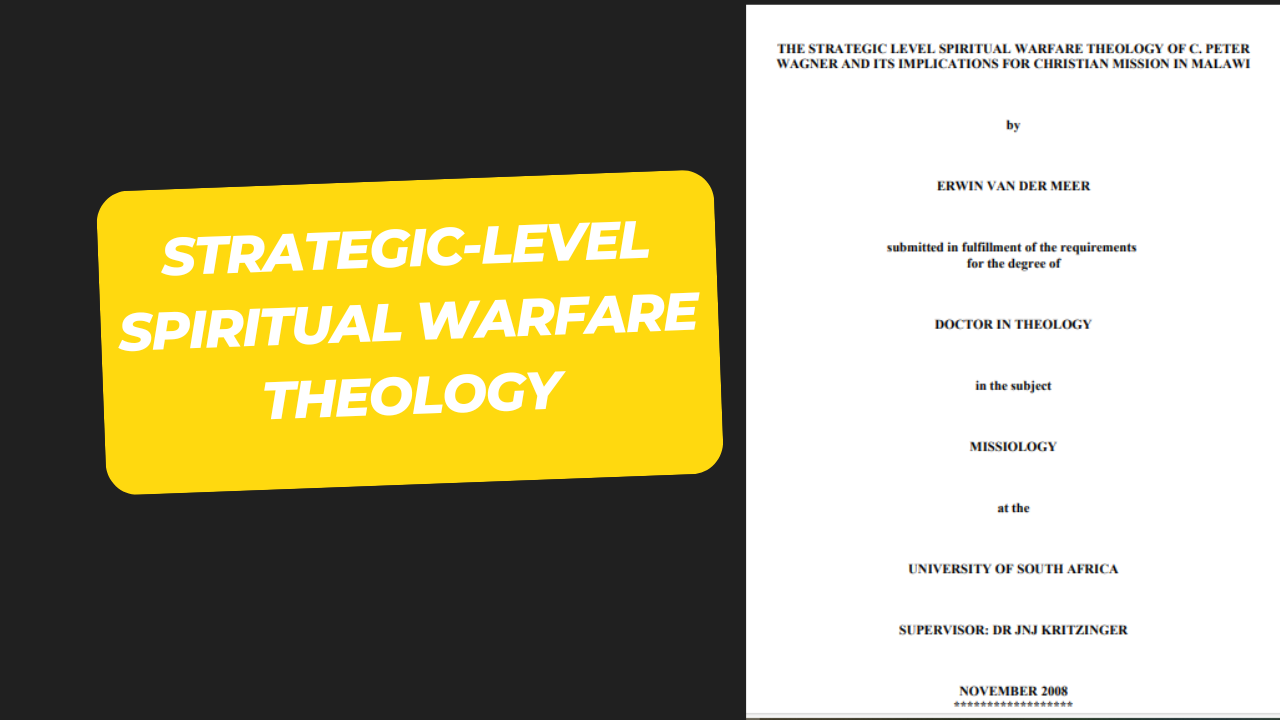

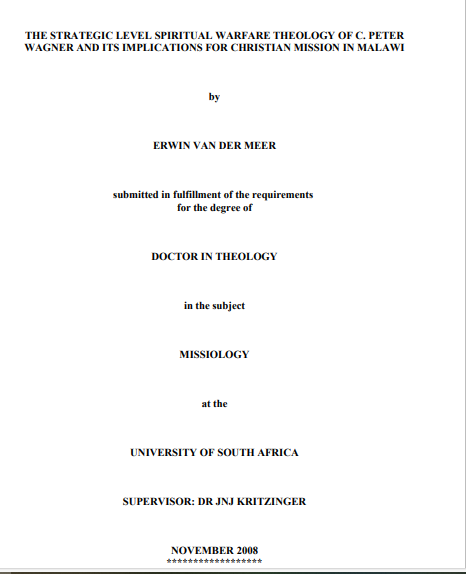
This text is a doctoral thesis examining the theological and missiological aspects of Strategic Level Spiritual Warfare (SLSW), a controversial approach to Christian mission championed by C. Peter Wagner. The author critically analyzes SLSW’s biblical basis, historical precedents, and contextual implications, particularly within the context of African Christianity. The thesis draws on various sources including Wagner’s own writings, critiques of SLSW, and relevant biblical and theological scholarship. A key focus is on evaluating SLSW’s compatibility with Evangelical missiology and its potential consequences in specific contexts, such as Malawi. The author ultimately argues against the adoption of SLSW, proposing a more balanced and biblically grounded approach to spiritual warfare.
1. What is Strategic Level Spiritual Warfare (SLSW) and what are its distinctive doctrines? SLSW is a theological perspective within Evangelical missiology that focuses on combating demonic forces, particularly those believed to control geographical territories. The primary distinctive doctrines of SLSW are: (1) the belief in territorial spirits, powerful demons that rule specific areas and their inhabitants; (2) the concept of territorial defilement, where past sins in a location give these spirits legal rights to control that place and its people, and (3) the need for identificational repentance to remove these legal rights. These are usually implemented by means of spiritual mapping, warfare prayer, and territorial commitment.
2. What is meant by the term “territorial spirits” in SLSW? In SLSW, territorial spirits are understood as high-ranking demonic entities that are assigned to and control specific geographical regions, such as cities, nations, or even neighborhoods. They are believed to oppose God’s purposes in their assigned area and influence human behavior by directing lower-ranking demons. Advocates of SLSW believe that these spirits need to be identified, often through a practice called spiritual mapping, and then directly confronted through warfare prayers. These spirits are also sometimes called “strongmen”.
3. What is the doctrine of territorial defilement? The doctrine of territorial defilement posits that territorial spirits gain a “legal right” to hold sway over a place due to past sins, evils, or negative events that have occurred in that location. This “spiritual garbage,” may include historical idolatry, violence, or other egregious acts. It is believed that these accumulated defilements provide a foothold for demonic influence and require repentance and cleansing to remove. Without this, the argument goes, the territorial spirits have a legitimate reason to continue their work in that territory.
4. What is “spiritual mapping” and what role does it play in SLSW? Spiritual mapping is a practice used in SLSW to identify territorial spirits, uncover historical “defilement” of a location, and discern the demonic entities and their areas of influence. It often involves gathering historical information, engaging in prayer, and seeking prophetic insights. The intention is to identify the specific names of these demons and the reasons why they hold sway over their territory in order to create targeted prayer strategies.
5. What is identificational repentance, and why is it important in SLSW? Identificational repentance, as practiced in SLSW, involves individuals or groups repenting on behalf of a community, location or nation for the past sins and evils that have allegedly given demonic forces a legal right to operate. This is not just about asking for personal forgiveness, but rather involves confessing and turning away from the sins of previous generations in a specific area. This repentance is seen as crucial in removing the legal foothold that territorial spirits have in the location, thereby preparing the way for more effective warfare prayer.
6. How does SLSW employ prayer? SLSW employs a variety of prayer strategies, often called “warfare prayer,” which focuses on engaging in spiritual battle against demonic powers. This can involve targeted prayer aimed directly at territorial spirits, including the breaking of curses and demonic attachments. It also involves verbal confrontations, binding and casting out territorial spirits. These prayers are often seen as part of a strategic approach that seeks to remove demonic influence, allowing the gospel to be received.
7. How does the concept of “territorial commitment” relate to modern apostles in SLSW? Within SLSW, the concept of territorial commitment refers to the idea that modern-day apostles have authority over specific geographical areas and the people in those areas. The idea is that these apostles are spiritual gatekeepers and are responsible for engaging in spiritual warfare within their territory. This involves engaging in practices such as spiritual mapping, identifying demonic strongholds, and commanding demons to leave in order to set the region free from spiritual bondage.
8. What are some of the theological and contextual critiques of SLSW? SLSW has faced various theological and contextual critiques. Some critics argue that its focus on a hierarchy of demons and their control over territories overemphasizes the power of Satan, potentially minimizing God’s sovereignty. Others question the biblical basis for the practice of identifying and naming territorial spirits, and see practices such as identificational repentance as having no biblical warrant. In addition, the approach has been criticised for misunderstanding the concept of territorial spirits in other cultural settings, as well as misapplying and exaggerating biblical passages to justify its practices. There are also concerns that the emphasis on spiritual warfare can overshadow other aspects of Christian mission.
Dispensationalism: A theological system within Evangelicalism that divides history into distinct periods or “dispensations,” each with a unique plan for salvation and God’s relationship with humanity.
Identificational Repentance: The practice of repenting on behalf of others or for the sins of a territory’s past, believed in SLSW to remove the legal basis for demonic control.
Intertestamental Period: The period between the end of the Old Testament and the beginning of the New Testament (approximately 400 BC – 4 BC), a time of Jewish apocalyptic literature and development of demonological concepts.
Locus Classicus: A Latin phrase meaning “classic place.” In this context, it refers to a specific scriptural passage that is considered the primary text for a particular doctrine.
New Apostolic Reformation: A neo-Pentecostal movement that emphasizes the role of modern-day apostles and prophets as having authority over the church and territories.
Spiritual Mapping: The practice of identifying and understanding the spiritual forces at work in a specific geographical area, often using historical research, prophetic insight, and information gathering.

Strategic Level Spiritual Warfare (SLSW): A set of beliefs and practices in some sectors of Evangelical Christianity that seek to engage in organized spiritual battles with demonic forces thought to control geographical territories and human populations.
Territorial Defilement: The belief that a geographical area or a people group becomes vulnerable to demonic influence due to past sins or evil practices committed within that area.
Territorial Spirits: In SLSW, these are powerful demonic beings believed to rule over specific geographical territories, nations, or communities.
Third Wave Movement: A movement within Pentecostalism that emphasizes signs and wonders, spiritual gifts, and the experience of the Holy Spirit, and which synthesized with the Church Growth Movement.

 Tim Ferriss & The Self-Improvement Trap: Is More Always Better?General
 The Self-Acceptance Protocol: Beyond Endless Self-ImprovementGeneral
 Beyond Bio-Hacking: The Science of Authentic Self-ImprovementGeneral
 Carl Jung: Life, Ideas & The Path to Spiritual WholenessGeneral
 Book Review: The Biology of Belief – Lipton’s Key LessonsGeneral
 Book Review: Breaking the Habit of Being Yourself by Dr. Joe DispenzaGeneralTim Ferriss & The Self-Improvement Trap: Is More Always Better?GeneralThe Self-Acceptance Protocol: Beyond Endless Self-ImprovementGeneral
Sign in without leaving this document. You will return here automatically.

The Ultimate Masters
https://www.ultimatemasters.org
Subscribe for one year to access all your favourite downloads
500 / year
Unlimited downloads forever
Unlimited downloads
Subscribe for one to access hundreds of downloads.
50 / month
Subscribe quarterly/per term
75 / month
The Ultimate Masters
https://www.ultimatemasters.org
Continue directly to this store’s secure WooCommerce checkout.
Earn direct and team commission with personal links, campaign creatives, discount coupons and transparent reporting.
0 responses on "Strategic-Level Spiritual Warfare Theology"